GLOBAL HYDRATION ONTOLOGY · VERSION 1.0 IN DEVELOPMENT

Wasser­botschafter & Mitwirkendenever defined together

Entdecke die Menschen, die dazu beitragen, dass World Water Movement gobal wächst, und bewerbe dich als Wasserbotschafter oder Mitwirkender.
SCOPE
Human hydration across the life course
PANEL
25-30 experts, all continents
KICK-OFF
World Water Day, 22 March 2027
RELEASE
Version 1.0, Q4 2027
ACCESS
Open licence, free core
WHY THIS EXISTS

Hydrated should mean the same thing everywhere

Physiology, nephrology, geriatrics, nutrition, sports science, occupational health and climate research all study how the body gains, holds and loses water. Each field describes it in its own terms. As a result, data cannot be compared, guidelines diverge, and the word "hydration" on a product label can mean almost anything.


In September 2026, an expert roundtable concluded that precise, consensus-backed definitions of hydration states are absent from the scientific literature. Its first recommended action: formally define them, for clinical practice, regulation, consumer education and research.

Source: Tahiri, Trumbo, Kavouras et al., Current Developments in Nutrition, 2026 · PubMed Central
THE GAP

One word. Many definitions - in the lab and at the bedside.

Physiology, nephrology, geriatrics, nutrition, sports science, occupational health and climate research all study how the body gains, holds and loses water. Each field describes it in its own terms. As a result, data cannot be compared, guidelines diverge, and the word "hydration" on a product label can mean almost anything.


In September 2026, an expert roundtable concluded that precise, consensus-backed definitions of hydration states are absent from the scientific literature. Its first recommended action: formally define them, for clinical practice, regulation, consumer education and research.

Source: Tahiri, Trumbo, Kavouras et al., Current Developments in Nutrition, 2026 · PubMed Central
No shared definitions
Even "dehydration" lacks an agreed definition.
No single reference measure
No one biomarker fits every person and setting.
Growing stakes
Heat, ageing populations and chronic disease make hydration a public health question.
WHAT WE ARE BUILDING

An open map of what we know about hydration.

Physiology, nephrology, geriatrics, nutrition, sports science, occupational health and climate research all study how the body gains, holds and loses water. Each field describes it in its own terms. As a result, data cannot be compared, guidelines diverge, and the word "hydration" on a product label can mean almost anything.


In September 2026, an expert roundtable concluded that precise, consensus-backed definitions of hydration states are absent from the scientific literature. Its first recommended action: formally define them, for clinical practice, regulation, consumer education and research.

Source: Tahiri, Trumbo, Kavouras et al., Current Developments in Nutrition, 2026 · PubMed Central

Our aims for version 1.0

1
Agree consensus definitions for the core concepts of human hydration.
2
Show how these concepts relate — from physiology and assessment to determinants and outcomes.
3
Mark every concept with its level of evidence.
4
Align with established health data standards, so the ontology fits into existing systems.
5
Publish it openly, with transparent governance.
WHAT VERSION 1.0 WILL CONTAIN

Focused on the human body. Connected to the wider world of water.
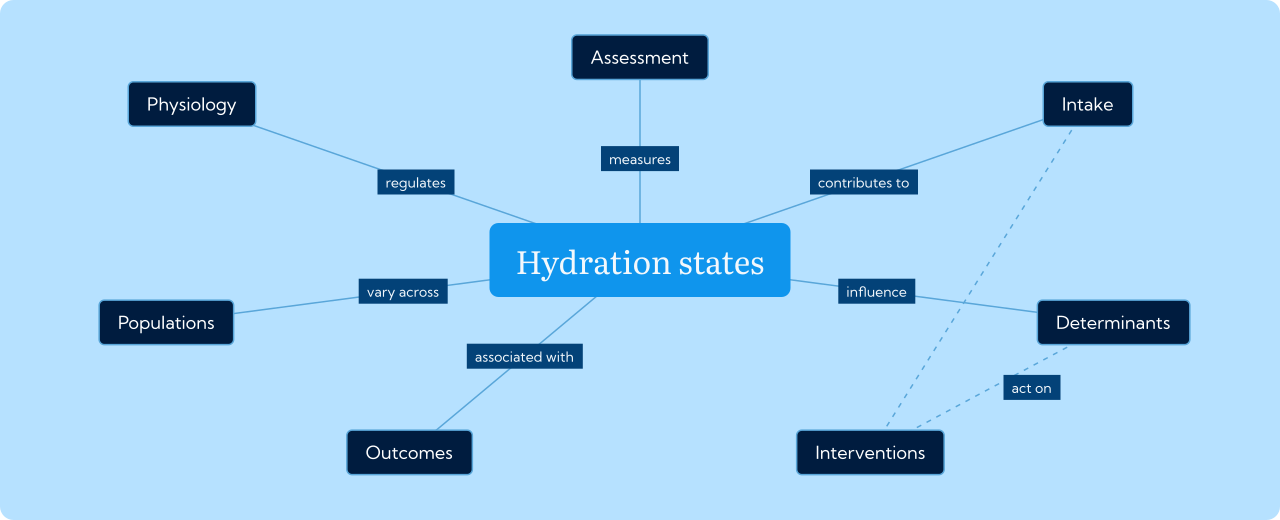
Version 1.0 covers human hydration across the life course. Water access, quality and the environment will connect to it as linked modules in later versions.
Illustrative. Final concepts and relations will be defined by the expert panel.
- - -  Later versions: water access · water quality · environment

Modules

Physiology
Fluid compartments, osmolality, thirst and hormonal regulation
Hydration states
Euhydration, underhydration, dehydration, hyperhydration
Assessment
Biomarkers, field indicators, wearables and when to use which
Intake
Water, beverages and the water in food
Determinants
Heat, work, age, medication, culture and access
Populations
Children, older adults, workers, athletes, patients
Outcomes
Kidney, metabolic, cognitive and healthy ageing
Interventions
Guidelines, school and workplace programmes, heat-action plans

What will be
published

The ontology in open, machine-readable formats
A plain-language glossary of the consensus definitions
Mappings to established health terminologies
A peer-reviewed consensus paper, co-authored by the expert panel
A policy brief for public health decision-makers

Languages

Version 1.0 is developed and published in English. The glossary and key documents will then be adapted into German, Spanish and French. Further adaptations, for example for Asian languages, are envisaged together with regional partners.
HOW IT WORKS

Built by experts, step by step, in the open.

1
Foundation
Until February 2027
In progress
Chair, ontology team and governance in place.
2
Expert panel
January to March 2027
In progress
25 to 30 experts from all continents join. First conversations have already started.
3
Co-creation
March to October 2027
Kick-off on World Water Day, 22 March 2027, followed by four focused sessions. Between sessions, experts contribute to short, concrete work packages; our ontology team consolidates the input.
4
Review and release
Q4 2027
Public comment period, then release of version 1.0.
Dates are targets and may shift as the panel forms.
OUR PRINCIPLES

Trust is the whole point.

A shared language only works if people trust where it comes from. These principles are binding for everyone involved.
Evidence first.
Every concept carries its level of evidence. Established knowledge, emerging findings and open questions are clearly distinguished.
Independent.
The scientific content is decided by the expert panel alone. Companies may observe and give feedback, but never vote on definitions.
Transparent.
Every panel member declares potential conflicts of interest. All funding sources are published.
Global.
Experts from every continent and from many disciplines, including voices from low- and middle-income countries.
Open.
The core ontology is free to use for everyone.
Rooted in Switzerland, open to the world
The ontology’s legal home is being established in Lucerne: a non-profit association under Swiss law, created to get the work started quickly. In a second step, it will be transferred into a Swiss foundation to secure it for the long term. Switzerland offers a stable legal framework and a long tradition of bringing nations together for international dialogue. As custodian, the association will:
hold the rights to the ontology, its name and its official version, and keep it open for everyone
manage all funding transparently and publish its sources
steward future versions, while every scientific decision stays with the independent expert panel
THE PEOPLE

A global panel, in formation.

The project is convened by the World Water Movement, a non-profit initiative based in Lucerne, Switzerland. A dedicated ontology team carries the modelling and consolidation work, so experts can focus on what only they can contribute: their knowledge and judgement.
Chair
A globally recognised hydration scientist
To be announced
Expert panel
25 to 30 experts across physiology, medicine, nutrition, public health, occupational and climate health, behavioural science, health informatics, anthropology and more. First conversations have already started.

If your work touches hydration please reach out.

Join as an expert

In progress
Adopter council
Governments, public health agencies and organisations who intend to use the ontology
In formation
Initiator and project lead
Oliver Wegner

Founder and CEO of the World Water Movement. Began his career at a German health insurer, then spent 30+ years in technology, building data platforms and advising CEOs on growth and strategy. Exploring water worldwide since 2021. No water-industry ties.
OPEN AND PROTECTED
Free to use. Safe to rely on.
The core ontology will be published under an open licence that allows anyone to use and build on it, with attribution. To keep it reliable, only the official release carries the project's name, and changes follow the panel's governance process. This is how established health standards stay both open and trustworthy.

Public institutions and researchers will always have free access to the core.
GET INVOLVED

Help the world speak one language of water.

FOR EXPERTS
Join the panel.
About 20–25 hours over eight months, four 90-minute sessions, co-authorship of the consensus paper.
FOR GOVERNMENTS, HEALTH
‍
SYSTEMS, INSURERS AND COMPANIES
Be a pilot adopter.
Apply the ontology early and help shape how it works in practice.
FOR RESEARCH INSTITUTIONS AND
ORGANISATIONS
Partner with us.
On funding, tooling or implementation.

Get in touch

Questions and answers

Why an ontology and not another guideline?

Guidelines tell people what to do. An ontology makes sure everyone means the same thing when they say it. It is the foundation that guidelines, health records, research data and digital tools can share.

How is the ontology funded, and how do you protect its independence?

text here

Will companies be able to influence the definitions?

No. Definitions are decided by the expert panel only. Organisations can observe and give feedback, and all funding sources are published.

How do you handle traditional and cultural knowledge about water?

With respect and with clarity. Cultural practices and beliefs around drinking water are part of how people hydrate, so they deserve a place in the map. They are documented in a separate, clearly labelled module and never presented as health claims.

How does this relate to the World Water Movement's other work?

The World Water Movement (WWM) is a global movement that works horizontally: rather than competing with existing initiatives, NGOs and non-profits, it connects them across borders and disciplines. Its aim is to create the conditions for millions of people to develop a new water consciousness. WWM convened this project. The scientific content is governed independently by the expert panel and its chair. The ontology’s legal home, a non-profit association under Swiss law, is being established in Lucerne, with a Swiss foundation as the long-term goal.

When will version 1.0 be available?

We aim to release it in the fourth quarter of 2027, after a public comment period.

Let's talk

Global Hydration Ontology · convened by the World Water Movement · Lucerne, Switzerland
ontology@watermovement.world